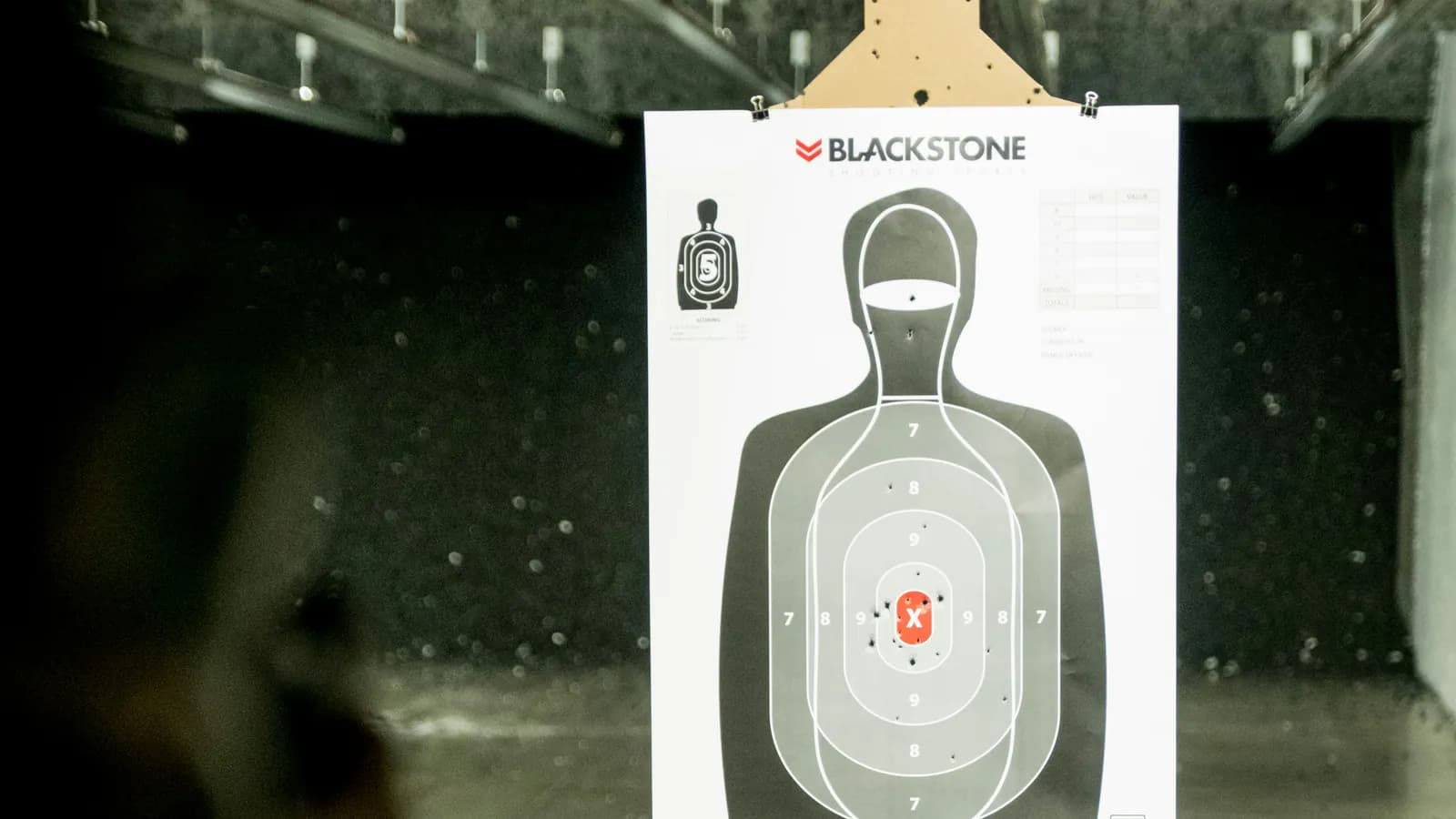
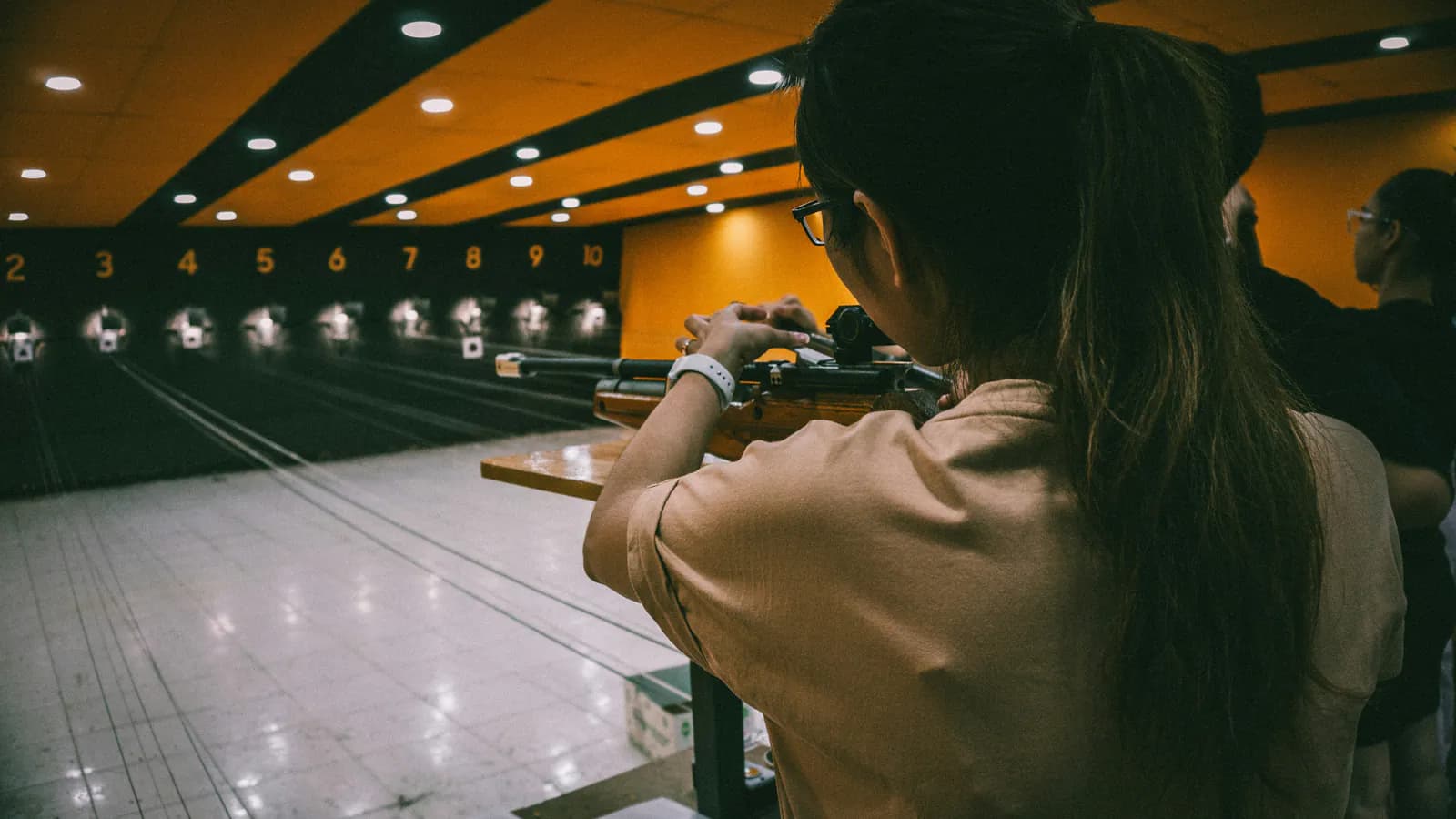
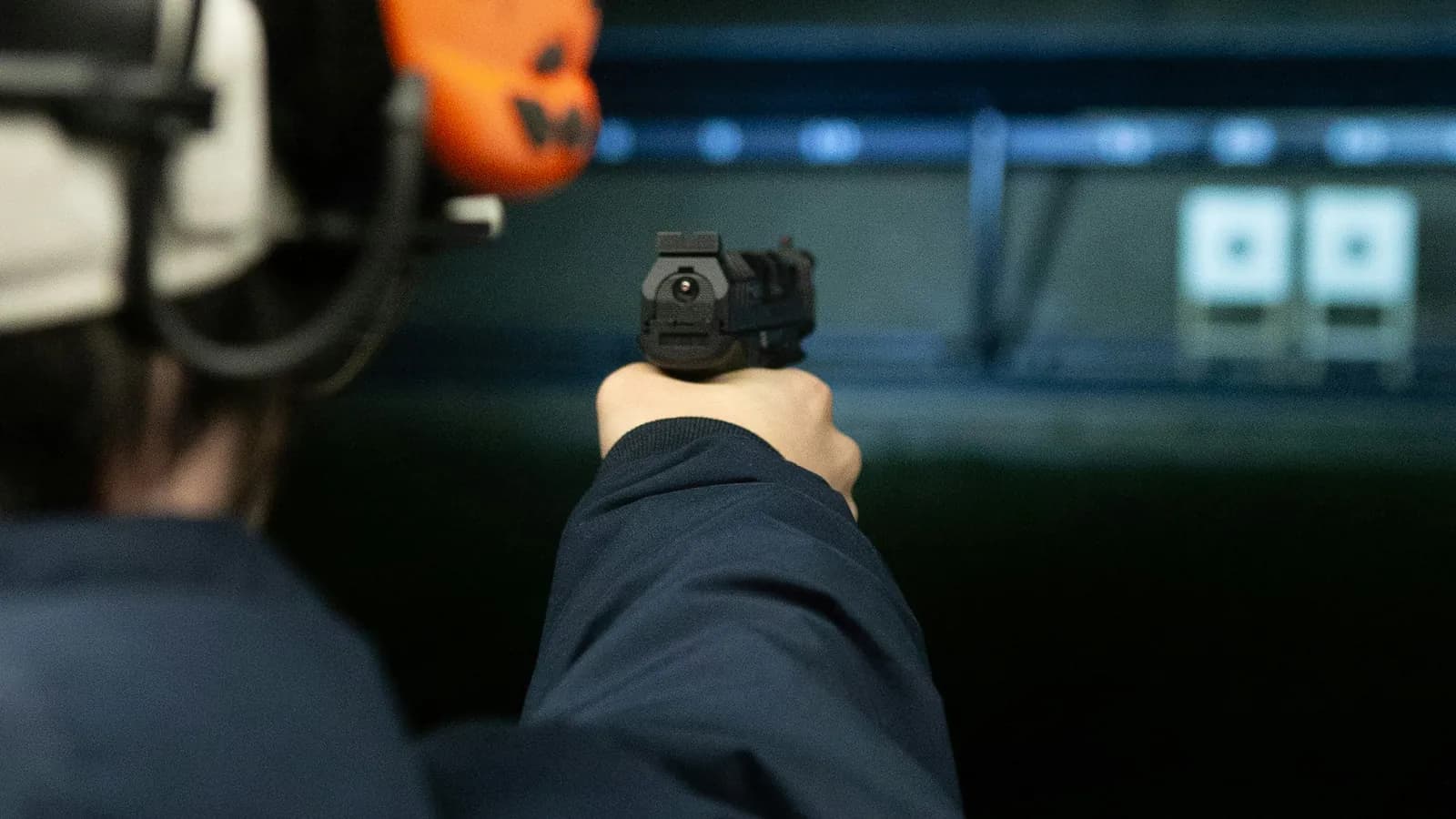
Every argument about zeroing is really an argument about which distance to pick. The mechanics are the same either way: the sight sits above the bore, the barrel is angled very slightly upward relative to what you are looking at, and the bullet crosses your line of sight on the way up and again on the way down. Choosing a zero is choosing where those two crossings land.
We already published the how. How to zero a red dot sight covers the procedure: torquing the mount, shooting groups, doing the adjustment math, and confirming. If you want the step by step, read that one. This post is the other half, the reference: which distance, for which firearm, and what each one costs you.
One rule before the numbers. Every figure below is approximate and depends on your load, your barrel length, and how high your optic sits. Treat them as the shape of the trajectory, not as data.
Sight height above bore is the variable behind all of it
The gap between the center of your optic and the center of the bore is what creates the two crossings in the first place, and changing it changes every number on this page.
A typical micro red dot on a low mount sits somewhere around two and a half inches above the bore of an AR-15. Raise it to a taller mount and the angle between the barrel and your line of sight gets steeper, which pushes the near crossing out, lifts the bullet higher through the middle of its span, and increases how far below the sight your rounds land up close. Lower it and the opposite happens.
None of that is a reason to avoid a taller mount, which has real ergonomic benefits, but it does mean you cannot borrow figures from a rifle that is set up differently to yours. AR-15 optic mounting height covers that tradeoff properly. On a pistol the same gap exists and it is much smaller, which is why pistol zeroing is a different problem entirely.
10 yards: the pistol zero
Pistols get zeroed close because pistols get used close. The offset between the sights and the bore is small, roughly three quarters of an inch on irons and about an inch to an inch and a third on a slide mounted dot, and a handgun round is not travelling far enough for trajectory to be the dominant problem. The shooter is.
Ten yards is the common default, and some shops and instructors use 15 or 25 instead. The reason it matters less than people expect: with the offset that small, a pistol zeroed at 10 yards is typically within an inch or two of point of aim all the way out to 25 yards. That is inside the size of the group most people can shoot at that distance anyway.
Who should pick it: anyone mounting a dot on a carry or duty pistol, and anyone confirming that a new set of sights actually shoots where it looks.
How it fails: at 10 yards, your own error is larger than the correction you are trying to make. A group that lands an inch left may be your grip rather than your sight. Shoot it supported, shoot more rounds than feel necessary, and adjust off the center of a group you would be willing to defend. Then confirm at 25 to see whether the story holds.
25 yards: a place to get on paper
On a rifle, 25 yards earns its place for practical reasons. Plenty of indoor ranges are 25 yards long, and at that distance you can see your holes without walking downrange or setting up a spotting scope. It is an excellent place to start and a poor place to finish.
A true 25 yard zero on a 5.56 carbine pushes the far crossing well out past 300 yards, with the bullet riding high through the middle of that span. It is a battlesight in shape, and it shares the same tradeoffs as the 36 yard zero below.
How it fails: error multiplication. The angle you are correcting at 25 yards is tiny, so every small mistake in reading the group gets multiplied by four at 100 yards and by twelve at 300. A quarter inch off at 25 is roughly an inch off at 100. Use 25 to get on paper and to burn as few rounds as possible finding it, then move back and confirm somewhere longer before you call the rifle zeroed.
36 yards: the wide span battlesight
Zero at roughly 36 yards and the far crossing lands somewhere near 300 yards with common 5.56 loads. That is the widest useful span you can get out of an unmagnified sight, which is exactly why militaries have gravitated toward zeros in this neighborhood.
The price is height in the middle. Somewhere around the 150 to 200 yard mark the bullet is riding meaningfully above your dot, peaking at roughly four inches with common loads, and that is a real miss on anything small or partially exposed.
Who should pick it: shooters who genuinely engage past 200 yards with an unmagnified optic, on targets large enough to absorb the mid range rise.
How it fails: you shoot over things. If most of your shooting is inside 200 yards, this zero is trading precision you use for reach you do not.
50 yards: the general purpose default
Zero at 50 and the bullet comes back down through your line of sight somewhere around 200 yards with common loads, and it never climbs much more than about two inches above the dot in between. That is the flattest, most forgiving arrangement available on a carbine.
The practical effect is that from the muzzle out to roughly 200 yards you put the dot where you want the hit and you are within a couple of inches. No holdover to remember, no mental arithmetic, and the two crossings sit far enough apart to cover essentially every distance a red dot is good for.
Who should pick it: most people, on most carbines, with a red dot or a low power variable. If you are not sure, this is the answer.
How it fails: past the far crossing the drop accelerates quickly, so beyond roughly 250 yards you are holding over and guessing unless you have magnification and a reticle with something to hold with. It also does nothing about the inside ten yards problem, where your rounds land low by the full height of your optic above the bore.
100 yards: the precision and known distance standard
The simplest zero to think about, which is most of its appeal. At 100 yards the crosshair is the hit, and there is no clever span to remember. It is the default for precision rifles, for scopes with holdover reticles or exposed turrets, and for anyone who is going to dial or hold for distance anyway.
What you give up is the flat span. Because 100 yards is far enough out that the two crossings collapse toward each other, there is effectively no useful window where the bullet rides above your line of sight. Everything closer than the zero is low, by an amount that approaches the full sight height as you get near the muzzle.
Who should pick it: magnified rifles used at known or measured distances, where the shooter is going to apply a correction for anything past the zero rather than rely on a forgiving band.
How it fails: it is the wrong tool on a red dot carbine. Close in, where an unmagnified rifle does most of its work, you are low and you have to remember to hold high.
Past the far crossing, the drop takes over
Beyond its far crossing every zero behaves the same way in shape: the bullet falls away from your line of sight, and it falls faster the further it goes. That much is common to all of them.
What does not happen is the zeros converging. Choosing a different zero means angling the barrel differently relative to your line of sight, and an angular difference does not wash out with distance, it opens up. Two zeros that sit a fraction of an inch apart at 100 yards are several inches apart at 400. Running the numbers for a 2.6 inch sight height, a 36 yard zero lands roughly 7 inches higher than a 50 yard zero at 400 yards, which in practical terms is the difference between holding on the top of the head and holding somewhere above it.
So what the zero really decides is the shape of the trajectory inside the band you can shoot without thinking, plus a modest and predictable offset past it. It buys you that band. It does not buy you range. If you want to shoot past the band with any confidence, what you need is magnification, a reticle you can hold with, and a known drop for your load. That is a different conversation, and it starts with understanding your adjustment units: see MOA vs MRAD.
A zero belongs to a load, not to a rifle
A 55 grain and a 77 grain load do not share a trajectory, and a 115 grain and a 147 grain pistol load do not either. Zero with the ammunition you actually intend to shoot, and if you keep one load for practice and another for serious use, confirm both and know the difference between them.
Write it down: the distance, the load, the bullet weight, the rifle, and the date. Every zero is a specific combination of gun, optic, mount, and ammunition, and any change to any of those means confirming again. Removing an optic, swapping a mount, or changing handguards all count, and quick detach mounts returning close is not the same as confirmed.
Confirm at distance, or it is only a guess
Whatever distance you pick, verify it somewhere longer than where you set it if you can. A carbine zeroed at 25 yards and never confirmed at 100 has an unknown zero, not a 25 yard one. The same logic applies to a pistol dot set at 10 yards: a quick group at 25 tells you whether the adjustment was real or whether you were reading your own error.
Confirmation is also when mount problems reveal themselves. A point of impact that walks between range trips is loose hardware far more often than it is bad ammunition. Torque matters, and so does the mount underneath the optic.
The recommendation
Pistol with a dot: zero at 10 yards, confirm at 25. General purpose carbine with a red dot or low power variable: 50 yards, every time. Magnified precision rifle: 100 yards, and learn your drops from there. Use 25 yards only to get on paper. All figures approximate and load dependent.
Where to go next
For the actual procedure, groups, clicks, and confirming, read how to zero a red dot sight. For the units your turrets speak in, and why mixing them up is the most common zeroing mistake there is, read MOA vs MRAD.
If the sight itself is still an open question, or the mount holding it is the weak link, start with optics and mounts and buy them as a pair rather than separately.
And if you would rather establish a zero on a live range with someone watching, that is one of the things our lessons cover, in person around Phoenix or live over video. It is a short session and it removes a lot of doubt.